
Use the latest browser recommended by Microsoft
Get speed, security and privacy with Microsoft Edge


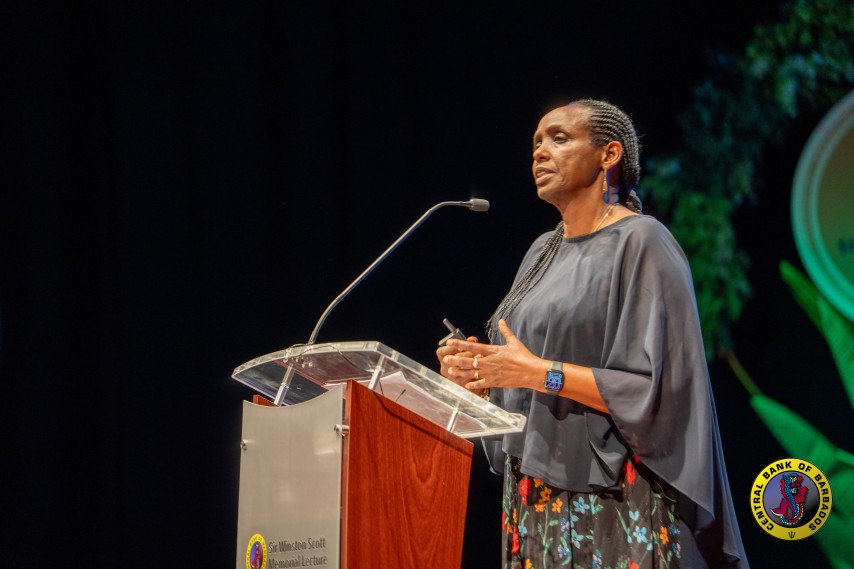
Dr. Agnes Kalibata, former President of the Alliance for a Green Revolution in Africa (AGRA), has warned Barbadians that climate change will continue to strain global food systems, and small island developing states such as Barbados must prepare for the resulting instability.
She made this assertion while delivering the 50th Sir Winston Scott Memorial Lecture at the Frank Collymore Hall.
Speaking on the topic “Feeding Tomorrow: Innovation Meets Climate Reality” during the Central Bank of Barbados-sponsored event, Kalibata grounded her lecture in global trends that she said are already reshaping how countries feed themselves.
She noted that many regions are experiencing weather extremes that are disrupting harvests and driving unpredictability in food supply. African farmers, she said, have been forced to adjust to changing rainfall patterns and prolonged dry spells, with direct implications for productivity and livelihoods.
She told the audience that climate-related disruptions in major food-producing regions can reduce global supply, elevate prices, and create ripple effects that reach import-dependent nations such as Barbados. She pointed out that world food markets are increasingly sensitive to shocks, and countries without buffers are most exposed.
Responding to the suggestion that young people are not interested in agriculture, Kalibata said financing for the sector is key.
“It's only a backyard activity when we can't harness it. It's only a backyard thing when we can't invest in it. It's only an area where young people don't go because it doesn't make sense. So, we have an opportunity to make this sector productive.”
The former Minister of Agriculture and Animal Resources in Rwanda said Barbados had already taken some policy decisions that other countries could learn from. She cited the country’s investment in greenhouse production, the tax on sugar-sweetened beverages, improvements in school meals, and the protection of agricultural land.
In a post-lecture discussion, Minister of Agriculture, Food, and Nutritional Security Indar Weir highlighted the Government’s efforts to build resilience, modernise agriculture, and reduce reliance on open-field farming, which is increasingly vulnerable to extreme weather. He outlined key initiatives involving aquaponics, the training of young farmers, the introduction of greenhouses in schools, and new vertical farming systems developed with international partners.
Weir said these efforts were already showing early gains. He also stressed the need for private-sector involvement and a stronger focus on value-added products.
Meanwhile, Central Bank Governor Dr. Kevin Greenidge said food security and climate resilience are intertwined with our economic stability and our quality of life.
“They affect everything from household budgets and public health to trade, tourism, and social equity. As a central bank, we recognise that climate risks can quickly become financial risks that affect production, investment, and long-term growth. In recent times, including just last week, we’ve seen first-hand how the unpredictable weather – drought followed by heavy rainfall – has impacted our agricultural outturn,” he said.