
Use the latest browser recommended by Microsoft
Get speed, security and privacy with Microsoft Edge


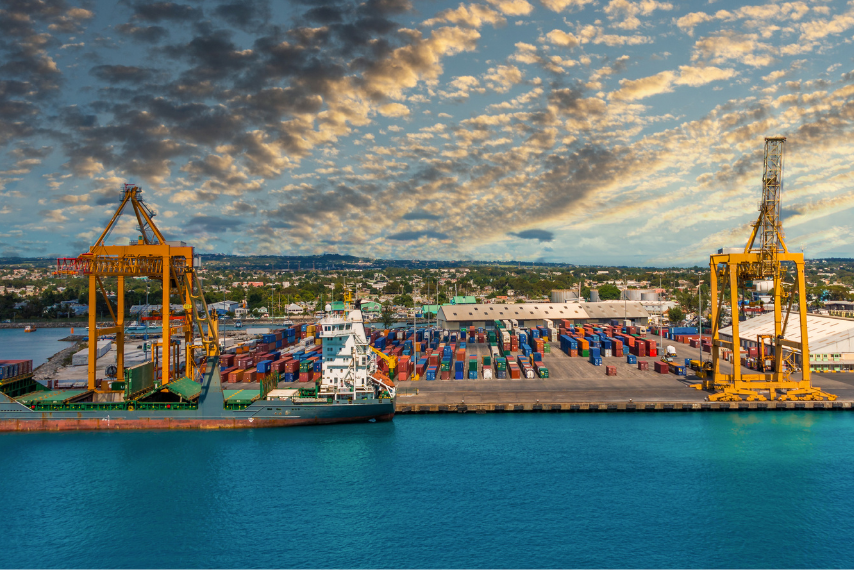
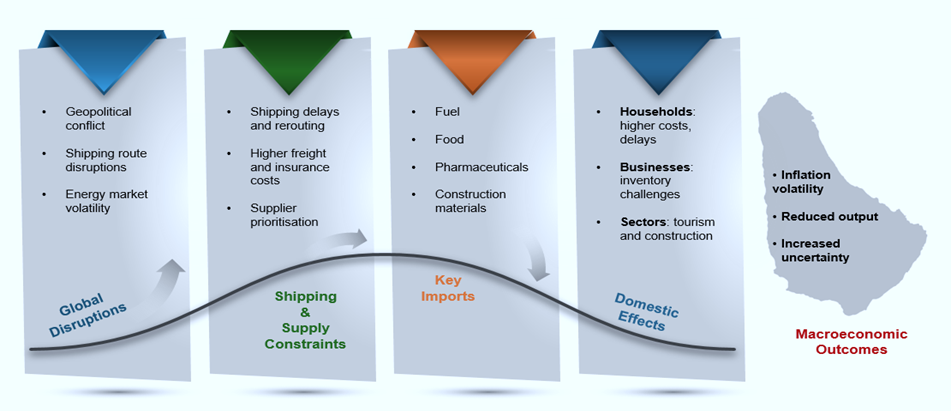
Recent global disruptions highlight the importance of import reliability for small, open economies. Geopolitical tensions and disruptions affecting major shipping and energy routes have increased uncertainty in global trade, energy, and maritime transport markets. For Barbados, these developments matter not only because they can raise prices, but because they can also affect the availability, timing, and reliability of essential imports.
Barbados’ import dependence creates exposure to supply chain disruptions. As a small island economy, Barbados relies heavily on maritime transport and imported goods to support households, businesses, and key productive sectors. Essential imports, including fuel, food, construction materials, pharmaceuticals, and medical machinery, account for roughly 48 percent of total imports. This concentration highlights why reliable access to critical imports matters for households, businesses, tourism, construction, and health services.
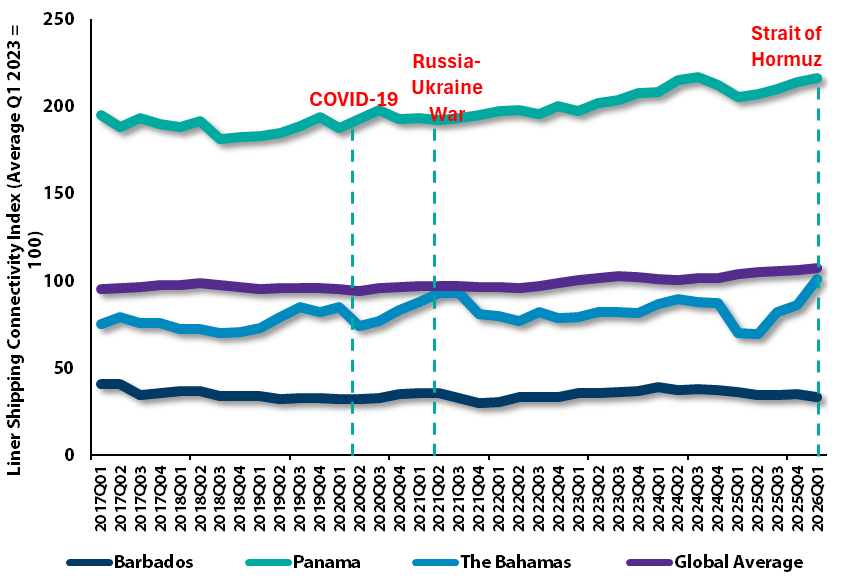
Limited shipping connectivity can make rerouting and supplier diversification more difficult. Barbados’ position within global liner shipping networks remains below major global and regional benchmarks[1]. Lower connectivity can limit the speed with which importers adjust when global shocks disrupt established routes or suppliers. As a result, external disruptions, including those affecting energy flows, grain shipments, or major maritime corridors, can influence the availability and cost of goods reaching Barbados, even when trade exposure is indirect.
Supply disruptions affect households, businesses, and major sectors through both prices and availability. Delays, higher freight and insurance costs, and supplier rationing can affect the timing, cost, and reliability of critical imports. These pressures can move through the economy by raising import costs, delaying delivery schedules, complicating inventory planning, and reducing the availability of key inputs. Households may experience delays in accessing essential goods or face greater price volatility. Businesses may face higher operating costs, inventory challenges, and project delays. Tourism and construction are particularly exposed, given their reliance on timely access to imported inputs and materials.
Building resilience requires attention to both prices and supply security. Barbados cannot eliminate import dependence, but it can reduce vulnerability through targeted resilience measures. These include strengthening storage capacity for critical goods, diversifying suppliers, deepening regional trade linkages, supporting select areas of domestic production, and accelerating renewable energy investment to reduce reliance on imported fuel over time. Recent global developments therefore reinforce the need to treat import reliability as a core part of economic resilience, alongside inflation control and external reserve management.
[1] The Liner Shipping Connectivity Index (LSCI), developed by the United Nations Conference on Trade and Development, measures a country’s integration into global liner shipping networks. It is calculated from the number of ships, their container carrying capacity, the number of services and companies, the size of the largest ship, and the number of other countries connected through direct linear shipping services. An increase in the index relates to higher connectivity. United Nations Conference on Trade and Development (2022)